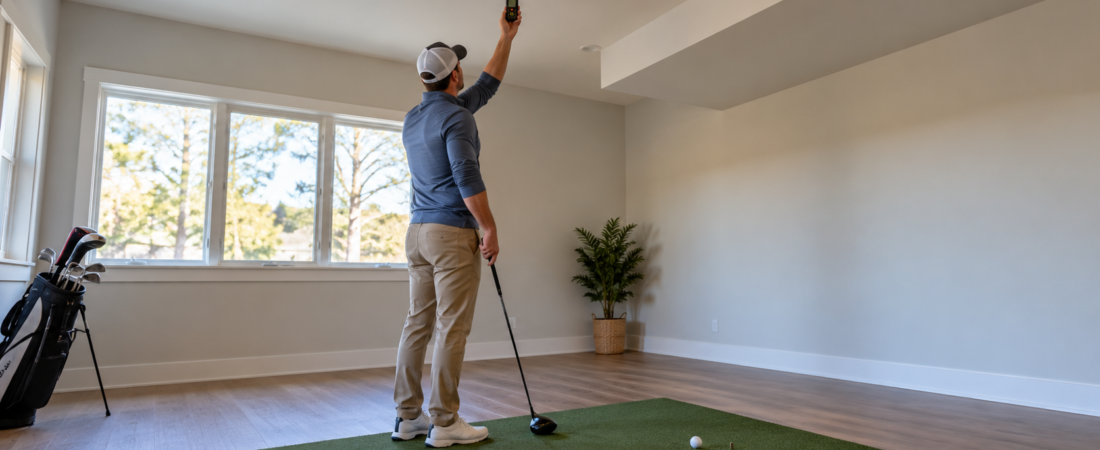
For most home golf simulators, a 10-foot ceiling is the best planning target. It provides enough clearance for most golfers to make a comfortable driver swing and leaves more flexibility for overhead launch monitors, projectors, and other ceiling-mounted equipment.
A 9-foot ceiling can still work for many golfers, particularly when the hitting position is carefully chosen and the golfer has a relatively compact swing. Below 9 feet, the chances of feeling restricted—or striking the ceiling with a club—increase considerably.
There is no single minimum ceiling height that works for everyone. The golfer’s height, swing plane, club length, and the room’s lowest obstructions matter more than the ceiling measurement alone. Testing the actual swing area before purchasing equipment is one of the most important steps in planning a home simulator.
Why a 10-Foot Ceiling Is the Best Target
A 10-foot ceiling gives most golfers enough room to swing a driver without consciously shortening or changing their motion. That extra confidence matters because even a technically sufficient ceiling can make a golfer tense or hesitant if the club feels close to the surface above.
The additional height also makes the simulator more accommodating for taller players, guests, and golfers with upright swings. A room designed around only one person’s current swing may become limiting when other people use it.
Ten feet also provides more flexibility when installing an overhead launch monitor, projector, lighting, or protective ceiling material. These components extend below the finished ceiling and can reduce the clearance available to the club.
Can a Golf Simulator Work With a 9-Foot Ceiling?
Yes, many home golf simulators operate successfully beneath 9-foot ceilings. Whether the space will work depends primarily on the golfer’s swing rather than height alone. Two golfers of the same height can require very different amounts of overhead clearance.
A golfer with a flatter or more compact swing may have ample room, while someone with a tall, upright follow-through may feel restricted. The driver is usually the most important club to test because it is longer than the other clubs and commonly produces the highest point in the swing.
A 9-foot room also leaves less flexibility for ceiling-mounted equipment. Projector brackets, overhead launch monitors, garage-door hardware, and protective padding must all be considered before deciding that the full ceiling height is usable.
What About an 8- or 8½-Foot Ceiling?
A ceiling between 8 and 8½ feet may work for some shorter golfers or for practice limited primarily to irons and wedges. It is much less likely to provide comfortable clearance for unrestricted driver swings.
The risk is not limited to physically hitting the ceiling. A golfer who believes the club may make contact can begin shortening the backswing or follow-through without realizing it, making indoor practice less natural and less useful.
A lower ceiling can also limit enclosure choices and rule out some overhead launch monitors or projector locations. Unless the intended golfers have tested the space successfully, it is risky to purchase a complete simulator system for a room in this height range.
Measure to the Lowest Obstruction
The listed ceiling height may not represent the clearance available where the golfer will stand. Beams, soffits, ductwork, ceiling fans, lights, garage-door tracks, and openers can all extend into the swing area.
Measure from the floor to the lowest obstruction above and around the intended hitting position. Check the full area traveled by the club rather than measuring only directly above the ball.
Remember to subtract the height of anything that will be added later. An overhead launch monitor, projector mount, acoustic treatment, or protective ceiling panel can turn an otherwise workable room into one that feels too confined.
Test the Swing Area Before You Buy
Clear the proposed hitting area and mark the intended ball position with painter’s tape. Wearing normal golf shoes, the primary golfer should make several slow, controlled swings with a driver while another person watches the club’s clearance from a safe position.
Test more than one swing. The club may reach different heights during a full backswing, follow-through, or harder swing than it does during a cautious first attempt. If there is any uncertainty, do not attempt a full-speed swing indoors.
Include the thickness of the future hitting mat in the calculation. A mat that raises the golfer an inch or two reduces the same amount of overhead clearance and can make a borderline ceiling unsuitable.
Allow for Overhead Equipment
Overhead launch monitors can keep equipment off the floor and preserve room depth, but they have their own mounting-height and placement requirements. Some models must be installed at a specific height and distance from the hitting area to track shots correctly.
Projectors also need enough clearance from both the golfer and the ball. A low ceiling may require a short-throw projector, a protective enclosure, or a mounting position that is offset from the swing path.
Check the manufacturer’s installation specifications before choosing either component. A room may provide enough height for the golfer’s swing but still be unsuitable for the preferred overhead equipment.
Ceiling Protection Does Not Replace Swing Clearance
Ceiling padding or protective panels can help prevent damage from high-angle shots, wedges, and accidental ball strikes. They should not be used to make an area with inadequate club clearance seem acceptable.
Repeatedly striking protective material with a club can damage the club, the ceiling, or the mounting system. More importantly, expecting contact can cause the golfer to alter the swing.
Plan enough open height for an unrestricted swing first. Add ceiling protection only where it is needed to control errant shots and protect the finished room.
What If the Ceiling Is Too Low?
If the driver cannot be swung comfortably, the room may still be useful for putting, chipping, or iron practice. A limited setup can provide value, but it should not be presented as a full-swing simulator if the golfer must change the normal motion to use it.
In a garage, relocating the hitting area or having the door tracks and opener professionally reconfigured may create additional clearance. In a basement, a different position may avoid low beams, soffits, or ductwork.
Structural alterations should be evaluated by qualified professionals. It is usually better to choose another room or adjust the simulator plan than to force a full-swing installation into a space that is not safely suited for it.
The Bottom Line
A 10-foot ceiling is the best target for most home golf simulators because it accommodates a wider range of golfers, swings, and equipment. A 9-foot ceiling can work well, but it should be tested carefully with the actual golfers and clubs that will use the space.
Rooms below 9 feet require much more caution and may be better suited to irons, wedges, or limited practice. No published measurement can replace confirming that the golfer has enough room to swing naturally.
Measure to the lowest obstruction, account for the hitting mat and overhead equipment, and test the intended hitting position before ordering an enclosure or simulator package. Adequate ceiling height protects the room, the equipment, and the quality of the practice experience.