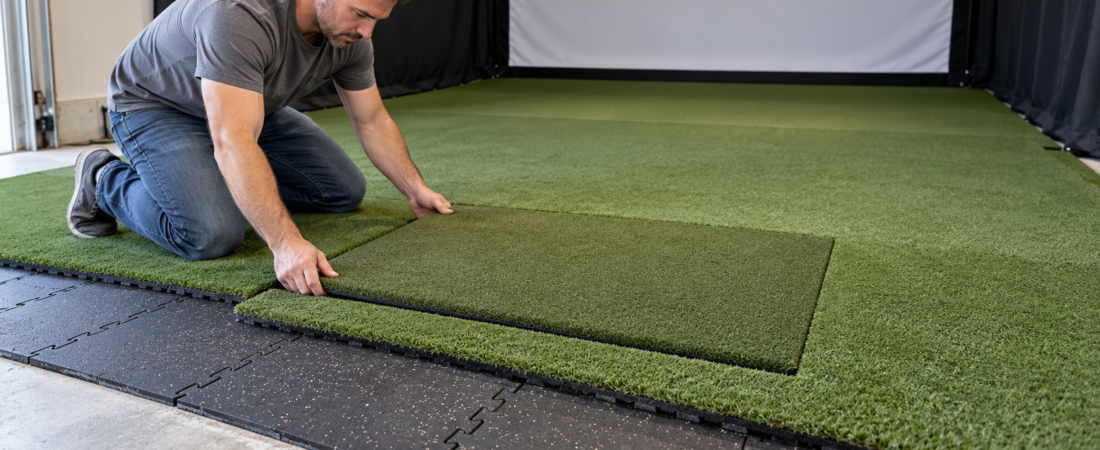
Flooring may not be the first thing you consider when planning a golf simulator, but it affects comfort, safety, noise, ball behavior, and the look of the finished room. At a minimum, golfers need a stable, properly cushioned hitting surface. Surrounding turf, foam tiles, and a raised subfloor are optional improvements that can make the simulator feel more complete.
The right flooring plan depends on the existing floor, the hitting mat, the launch monitor, and how the room will be used. A garage with sloped concrete presents different challenges from a finished basement or spare room. Planning the full surface before purchasing individual pieces helps prevent uneven footing, exposed edges, and incompatible heights.
The Hitting Mat Is the Essential Component
A home golf simulator does not require artificial turf across the entire room, but it does require a suitable hitting mat. The mat provides the surface from which the ball is struck and protects both the floor and golfer from repeated club impacts.
A quality mat remains stable during the swing and provides enough cushioning for repeated practice. Striking down into a thin mat placed directly over concrete can feel harsh and may place unnecessary stress on the hands, wrists, and elbows.
The golfer should stand at the same height as the ball. If a separate hitting strip is used, the stance area must be raised to match it. Standing above or below the ball can alter posture and make the practice setup feel unnatural.
Hitting Strip or Full-Size Mat?
A hitting strip is a narrow replaceable section designed to receive club impacts. It can be installed between stance mats, inserted into surrounding turf, or recessed into a larger platform.
One advantage of a replaceable strip is that the highest-wear area can be changed without replacing the entire floor. It may also allow the golfer to select a more forgiving hitting surface while using less expensive material elsewhere.
A full-size hitting mat combines the stance and hitting areas into one unit. It is usually easier to place and move because fewer pieces must be aligned. Larger mats may also accommodate different ball positions or both right- and left-handed golfers.
The best choice depends on the room, budget, and desired appearance. Either approach can work when the finished surface remains level, secure, and comfortable.
Why Add Turf Around the Hitting Area?
Artificial turf surrounding the hitting mat is primarily an optional finish rather than a simulator requirement. It can create a more polished appearance, reduce the visual transition between separate components, and make the room feel more like an indoor golf space.
Turf can also soften the ball’s landing after it drops from the impact screen. Compared with bare concrete or hard flooring, it may reduce noise, limit unpredictable bouncing, and help the ball roll more naturally.
Room-wide turf can conceal foam tiles, a subfloor, wiring channels, or the edges of a recessed hitting mat. It may also support putting practice when the selected material and underlying surface are suitable.
Not All Artificial Turf Is the Same
Artificial turf varies in pile height, density, backing, texture, and intended use. Decorative landscape turf is not necessarily suitable for hitting or putting, and a hitting surface may not provide a smooth ball roll.
Putting turf generally has a shorter, denser surface designed to allow predictable roll. Longer turf may look more like grass and provide cushioning, but it can slow or deflect the ball.
A room can use different materials for different purposes. A dedicated hitting strip can handle club impacts, lower-pile turf can provide a putting and ball-return surface, and separate stance material can support the golfer.
Request samples when possible. Appearance, feel, thickness, and ball roll can be difficult to judge from photographs alone.
Start With a Flat, Stable Base
The finished simulator floor depends on the surface beneath it. Concrete, plywood, tile, carpet, and finished wood each create different installation concerns.
The base should be stable, reasonably level, and free from loose material. Uneven areas can cause the hitting mat to rock, create visible seams, or affect the path of a rolling ball.
A firm surface is generally better than bare soil, grass, or another base that can shift. Before installing turf or a platform, address significant cracks, moisture, drainage, or structural concerns appropriately.
If the floor is intentionally sloped, as many garage floors are, determine whether that slope will interfere with the golfer’s stance, ball position, launch monitor, or putting surface.
Foam Tiles as an Underlayer
Interlocking foam tiles are a common way to add cushioning and raise the surrounding floor to the height of a hitting mat. They are relatively easy to install and can often be cut to fit around the room.
Foam may help reduce noise from balls dropping or bouncing on a hard floor. It can also provide a softer surface under artificial turf.
The density and thickness matter. Very soft foam may compress under the golfer, furniture, or equipment and create an unstable surface. Lower-quality tiles may separate or develop uneven areas over time.
The foam should support the intended use without allowing the hitting area to shift. Test a small section with the planned turf and mat before covering the entire room.
When a Raised Subfloor Makes Sense
A raised subfloor can create a level, continuous surface and allow the hitting mat or strip to sit flush with the surrounding turf. It may also provide space for wiring, putting cups, or other built-in features.
Wood-framed platforms and similar systems are more permanent than loose foam tiles. They require accurate construction and must support the golfer, equipment, and furniture without movement.
A platform adds height, which reduces the effective ceiling clearance. Even a few inches can matter in a room where the driver already passes close to the ceiling.
A raised floor may also affect doors, steps, electrical outlets, and transitions into the room. Consider these details before deciding that a built-in platform is necessary.
Keep the Hitting Area Level
The golfer’s feet and ball should remain on the same level unless the mat is specifically designed for another arrangement. A noticeable height difference can change posture, balance, and the apparent position of the ball.
The launch monitor may also need to sit on the same plane as the hitting surface. Some units are sensitive to changes in height or tilt, and their placement instructions should be followed carefully.
If the hitting strip, stance mat, and surrounding turf come from different manufacturers, compare their actual finished thicknesses. Listed measurements may not include compression or the material installed underneath.
Small differences can sometimes be corrected with appropriate underlayment. Avoid makeshift shims or loose layers that may move during use.
Plan for Right- and Left-Handed Golfers
A setup used by only a right-handed golfer may require a relatively compact stance area. A shared simulator needs enough level flooring on both sides of the ball.
A wider mat or centered hitting strip can allow right- and left-handed golfers to use the same ball position. This may prevent the launch monitor, projector alignment, or simulator software from needing to be adjusted whenever players change sides.
Measure the stance and swing positions for both orientations before cutting turf or building a platform. Equipment and seams should remain outside the areas where golfers place their feet.
Consider Ball Return
Some simulator floors are designed with a slight slope so balls roll back toward the golfer after striking the screen. Foam bumpers or other ball-return components can also direct balls away from the lower enclosure frame.
A ball-return feature can be convenient, but it should not create an uneven stance or cause balls to roll into the golfer’s feet during the swing. The slope should begin outside the primary hitting area.
The turf must allow the ball to roll without catching on seams or thick fibers. Test the proposed material and slope before permanently fastening the floor.
If a mechanical or built-in return is not necessary, a flat cushioned landing area may be simpler and less expensive.
Reduce Noise and Bounce
Bare concrete, tile, or wood can make the ball’s landing sound nearly as noticeable as its impact against the screen. Hard flooring can also produce erratic rebounds.
Turf over foam or another suitable cushioned layer can soften the landing area and reduce room noise. Padding near the lower screen and enclosure frame may further limit hard contact.
Flooring cannot correct a screen that is too tight or too close to the rear wall. Screen tension, rear clearance, frame protection, and floor cushioning should work together to control the ball after impact.
Protect Against Basement Moisture
Concrete basement floors can transmit moisture even when no standing water is visible. Installing foam, wood, or turf over a damp slab may trap moisture and create odors or damage.
Before covering the floor, look for evidence of water intrusion, condensation, staining, or previous repairs. Address the source of the moisture rather than simply covering it.
Depending on the floor and construction method, an appropriate moisture barrier or underlayment may be needed. Local conditions and building requirements vary, so obtain qualified advice when moisture is a concern.
Turf and wood materials should be kept dry, and the room should have adequate ventilation and humidity control.
Account for Garage Conditions
A garage simulator floor may need to accommodate slope, temperature changes, dirt, vehicle use, and occasional moisture. Permanent wall-to-wall turf may not be practical if the room must continue functioning as a garage.
Modular mats and removable turf sections can provide flexibility. They can be moved for cleaning, storage, or vehicle access when necessary.
Garage floors should be clean and dry before foam tiles or turf are installed. Oil, moisture, dust, and uneven coatings may prevent adhesives from bonding or allow loose flooring to shift.
Do not block floor drains or create a surface that traps water. A removable installation may be safer where snow, rain, or vehicle moisture enters the garage.
Allow for Floor-Mounted Equipment
A floor-mounted projector, launch monitor, computer stand, or ball-return system may occupy part of the simulator floor. Their locations should be determined before turf is cut or permanently attached.
Cables should not run loose across walking or hitting areas. A raised floor may conceal low-voltage wiring, but electrical work and permanent power connections must be handled appropriately.
Equipment placed between the golfer and screen should be protected from direct shots and rebounds. Its enclosure should remain stable on the finished floor without creating a trip hazard.
Choose an Installation Method
Turf may be installed loosely, attached with hook-and-loop material, taped at the seams, or adhered more permanently. The correct method depends on the backing, underlayment, room use, and manufacturer’s instructions.
A loose installation is easier to remove but may develop ripples or shift. Permanent adhesive can produce a cleaner result but makes later changes and repairs more difficult.
Seams should remain flat and outside the golfer’s stance whenever possible. Edges near doorways or transitions may require secure trim to prevent curling and tripping.
Before permanently fastening anything, lay out the entire floor and confirm that the mat, turf, equipment, doors, and enclosure fit as intended.
Plan for Cleaning and Replacement
Golf simulator flooring collects dust, grass, dirt from shoes, rubber tee fragments, and debris from balls and clubs. Choose materials that can be vacuumed or cleaned according to their manufacturer’s instructions.
The hitting area will usually wear faster than the surrounding turf. A replaceable hitting strip or modular mat can simplify long-term maintenance.
Avoid permanently trapping a high-wear component beneath large sections of glued turf. The design should allow the mat, strip, or damaged flooring section to be replaced without dismantling the entire simulator.
Build the Floor Around the Way You Will Use It
The essential flooring component in a home golf simulator is a stable, cushioned hitting surface. Room-wide turf, foam tiles, raised platforms, putting areas, and ball-return features are optional additions that can improve the experience when they are planned correctly.
Begin with the existing floor and decide whether the simulator will be permanent or removable. Match the heights of the hitting mat, stance area, launch monitor, and surrounding turf. Account for moisture, room slope, ceiling clearance, and equipment placement before installing anything permanently.
A good simulator floor should feel level and secure without drawing attention to itself. When the surfaces work together, the golfer can focus on the swing rather than uneven footing, excessive noise, or balls bouncing unpredictably around the room.